
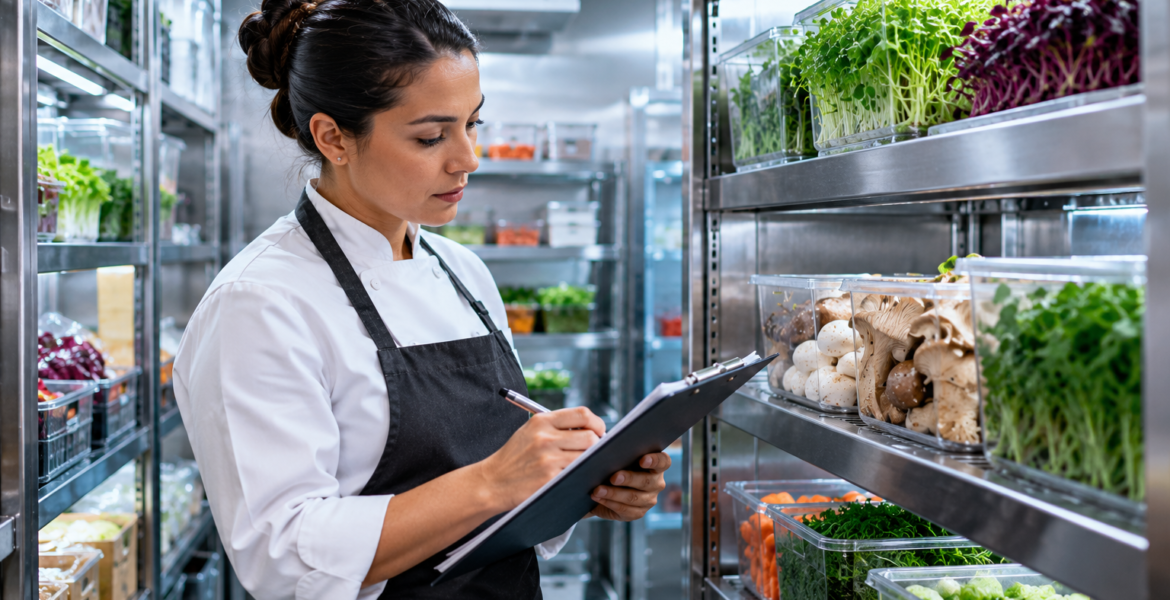
Every kitchen tracks food cost. Fewer track what ends up in the bin. Yet every tray of microgreens that wilts before service, and every punnet of mushrooms that turns before it’s used, is money spent and never earned back.
Waste is rarely one big mistake. It’s a series of small ones, and many of them start before the produce even arrives.
Where kitchen waste really comes from
When kitchens audit their bins, the same culprits tend to appear. Produce that was over-ordered because the last delivery was late. Stock that arrived close to the end of its life. Prep done too early for a service that turned out quieter than expected. Portions that vary from cook to cook.
Some of these are kitchen habits. Many of them are supply problems in disguise. If you can’t trust when your produce will arrive or how long it will last, you build in buffers, and buffers turn into waste.

Freshness at delivery decides shelf life in your cold room
Produce doesn’t start ageing when it reaches your kitchen. It starts the moment it’s harvested. If it has already spent days in transit or in a warehouse, a big part of its usable life is gone before you open the box.
That’s why the question to ask a supplier isn’t only ‘how fresh is it?’ but ‘when was it harvested?’
Harvested to order vs. sitting in storage
At The Local Farmer, our mushrooms and microgreens are harvested to order. They never sit in cold storage waiting for a buyer. Longer usable shelf life in your kitchen means less spoilage and fewer write-offs each week.
For microgreens especially, which are delicate by nature, those extra days can be the difference between a full tray on the pass and a tray in the bin.

Predictable delivery means smaller, smarter orders
When deliveries are unreliable, kitchens protect themselves by over-ordering ‘just in case’. It feels safe, but it’s one of the biggest drivers of waste.
A dependable delivery schedule lets you order closer to what you’ll actually use. Less buffer stock, less spoilage, and a cold room that’s easier to manage.
Stable pricing means accurate food-cost planning
Price volatility makes it hard to cost a dish and keep it costed. Stable, transparent pricing lets you set menu prices with confidence and see where your margins are really going, whether that’s portioning, prep or waste.
Track it to cut it: a simple weekly waste log
You can’t reduce what you don’t measure. A basic waste log takes a few minutes a day and quickly shows where money is leaking.
- Record what was thrown away, how much and why (spoiled, over-prepped, returned plate, damaged on delivery).
- Review it once a week with your sous chef or kitchen manager.
- Look for patterns: the same product, the same day of the week, or the same reason coming up again and again.
- Adjust order quantities, prep lists and storage based on what you find.
After a few weeks, most kitchens find two or three quick fixes that make a visible difference to food cost.
Four quick waste-control habits for mushrooms and microgreens
- Store correctly: keep mushrooms in breathable packaging in the fridge, and keep microgreens chilled and dry until use.
- First in, first out: rotate stock at every delivery so older produce is used first.
- Portion to the plate: set a standard portion for each dish so your team isn’t guessing.
- Prep close to service: cut and dress microgreens as late as possible to keep them crisp.
The role of your supplier
Your supplier should make waste control easier, not harder. Ask how soon before delivery your produce is harvested, how consistent delivery days are, and how pricing is set. A good partner will be able to answer all three clearly. At The Local Farmer, our answer is simple: harvested to order, delivered on a predictable schedule, with stable and transparent pricing.
“More control. Less uncertainty. Better performance — every service.”
The bottom line
Waste control starts with supply. Fresher produce, harvested to order and delivered on a schedule you can trust, gives your kitchen more usable product for every rand you spend.