
Ask any head chef what keeps them up at night and the answer is rarely the menu. It’s the supply behind it. A delivery that arrives late. A box of produce that doesn’t match last week’s quality. A price that jumps without warning. Stock that spoils before it reaches the pass.
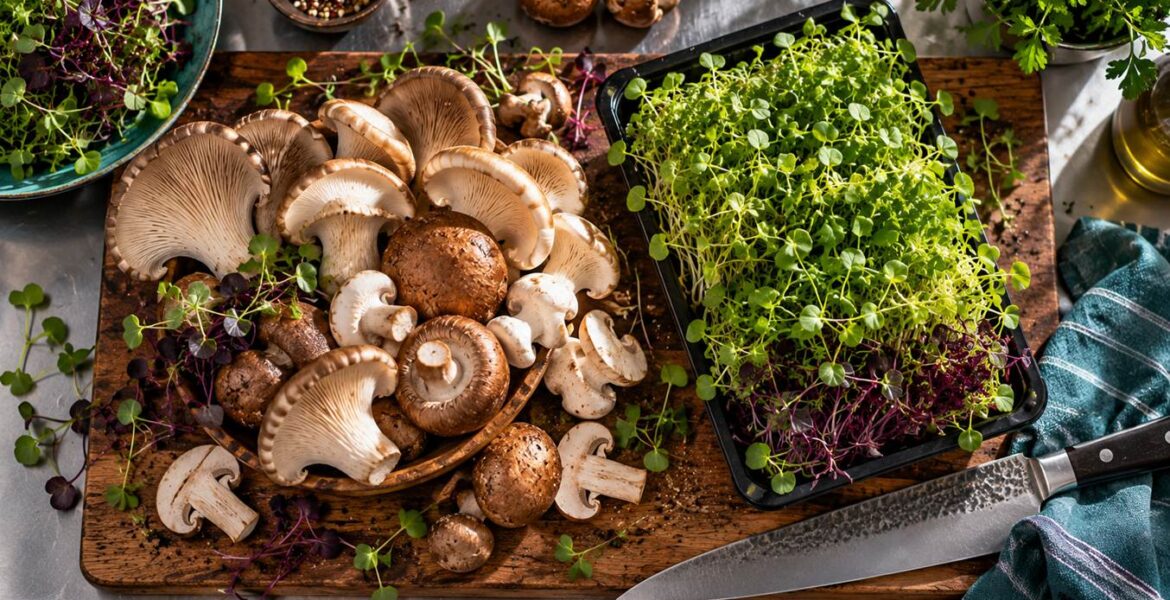
Fresh produce should be predictable, not a daily challenge. That’s the thinking behind The Local Farmer. We grow two crops for commercial kitchens, Mighty Mushrooms and Mighty Microgreens, and this month we’re showing why they work so well on their own and even better together.
Meet Mighty Mushrooms
Our mushrooms are grown in carefully controlled environments, harvested at peak freshness and delivered directly to your kitchen. They are grown naturally with zero pesticides and harvested to order, so they never sit in cold storage waiting for a buyer.
For chefs, that means an earthy, rich flavour and a texture that holds up in the pan, on the grill or in a slow braise. Mushrooms are one of the most versatile ingredients in a commercial kitchen. They work at breakfast, lunch and dinner, and they carry flavour in vegetarian dishes as well as meat-based ones.

Meet Mighty Microgreens
Microgreens are often treated as a garnish. They deserve more credit than that. Research has found that microgreens can contain up to 40 times more nutrients than their fully mature counterparts (Xiao et al., 2012). They are rich in vitamins A, C, E and K, and high in antioxidants and phytonutrients (USDA, 2024).
On the plate, they add colour, freshness and a clean finish. On the menu, they give you a genuine health and premium story to tell your guests.
Better together on one plate
Mushrooms bring depth: savoury, earthy and satisfying. Microgreens bring lift: fresh, bright and vibrant. Put them together and you have a simple formula for dishes that look good and taste balanced.
Think a mushroom risotto finished with a small handful of microgreens, a breakfast plate with sautéed mushrooms and a fresh green crown, or a gourmet burger with both. The combination is easy to apply across a menu, and it gives your team a consistent finishing standard.
What local, controlled-environment growing means for your kitchen
Growing in controlled environments means our crops aren’t at the mercy of the weather. That supports the three things commercial kitchens care about most:
- Consistent quality: the same standard, delivery after delivery, so your signature dishes stay the same.
- Predictable delivery: dependable schedules that remove last-minute sourcing scrambles.
- Better cost control: stable, transparent pricing that makes food-cost planning simpler.
And because we’re local, your produce spends less time travelling and more time at its best in your kitchen.
Who we grow for
We supply restaurants, cafés, hotels, caterers and other commercial kitchens that can’t afford to gamble on their ingredients. Our customers range from busy breakfast spots that go through mushrooms every morning to fine-dining kitchens that use microgreens as a signature finish on every plate.
What they have in common is simple: they need produce that turns up on time, looks the same as last week and lasts long enough to be used. Chefs want to spend their energy on cooking, not on chasing suppliers or reworking dishes because an ingredient didn’t arrive.
Why it matters for procurement, not just the pass
Reliable produce isn’t only a kitchen issue. For owners and procurement managers, every late delivery, emergency top-up order and spoiled box shows up in the numbers. Unpredictable supply makes it harder to forecast, harder to cost dishes and harder to hold margins steady through the year.
Choosing a local grower with controlled-environment production is a way to take some of that uncertainty out of the business. You get a clearer picture of what you’ll receive, when you’ll receive it and what it will cost.
What to expect from us this month
Throughout October, we’ll be sharing practical content for commercial kitchens on our blog, social channels and email: how fresher produce helps cut waste, five easy ways to pair mushrooms and microgreens on your menu, and how to plan your summer menu on a supply you can trust. Each piece is short, practical and written with busy kitchen teams in mind.
“Fresh produce should be predictable, not a daily challenge.”
The bottom line
Two crops. One local farm. A supply you can plan around. Over the coming weeks we’ll dig into how fresher produce reduces waste, how to pair mushrooms and microgreens on your menu, and how to plan for the busy summer season.
Follow TLF for more.
References
Xiao, Z., Lester, G.E., Luo, Y. and Wang, Q. (2012) ‘Assessment of vitamin and carotenoid concentrations of emerging food products: edible microgreens’, Journal of Agricultural and Food Chemistry, 60(31), pp. 7644–7651.
United States Department of Agriculture (USDA) (2024) Microgreens nutritional information. Available at: www.usda.gov