
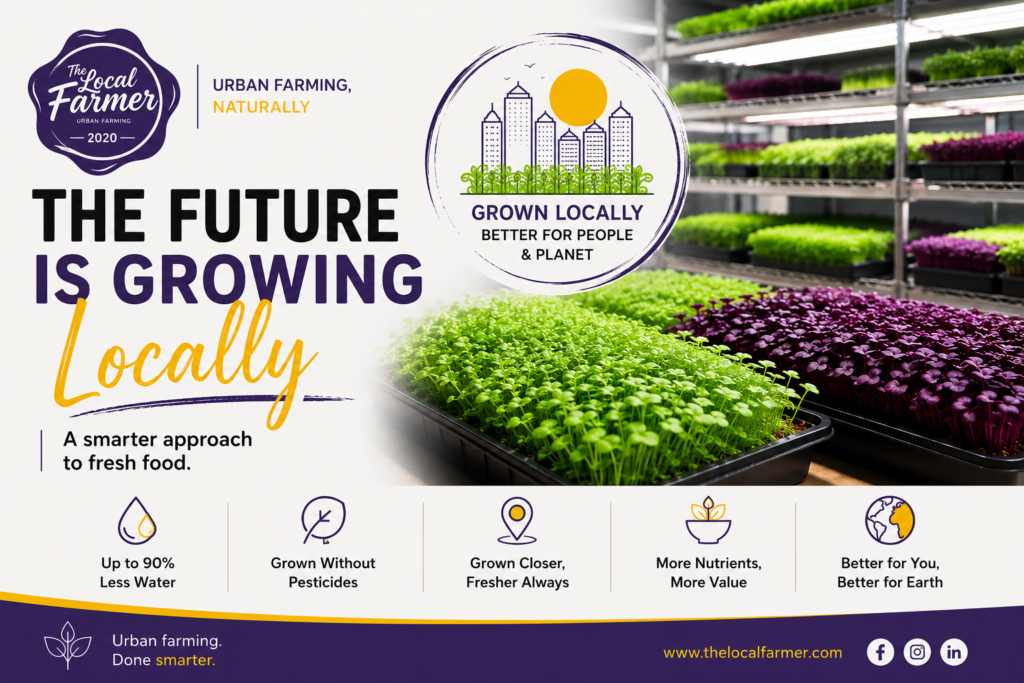
When people think about the future of food, they may imagine laboratories, unfamiliar ingredients, or highly complicated technology.
The reality can be much simpler.
The future can look like fresh microgreens grown inside cities, using less water, no
pesticides, and significantly less space than many traditional growing methods.
This is not a distant possibility. It is already happening.
Feeding growing cities
Cities continue to expand, while available agricultural land and reliable water supplies
face increasing pressure.
At the same time, consumers want food that is:
● Fresh
● Nutritious
● Responsibly grown
● Traceable
● Convenient
● Available throughout the year
Traditional agriculture remains essential, but it does not need to work alone.
Urban farming can support the wider food system by producing suitable crops closer to
the communities that need them.
Microgreens are particularly well suited to this model because they grow quickly, require
limited space, and can offer concentrated nutritional value.
More from every mouthful
Microgreens are harvested during an early stage of plant growth.
Depending on the variety and nutrient measured, some microgreens may contain up to
40 times more nutrients than their mature counterparts.
This gives people a practical way to add additional nutritional value to everyday meals
without increasing portion sizes or completely changing their diets.
A small amount can make a meaningful contribution.
That makes microgreens particularly useful for modern lifestyles, where people want
healthier choices that remain simple and convenient.
More from every drop
The future of food will depend heavily on how responsibly resources are used.
Well-managed soil-free farming systems can use up to 90% less water than
conventional growing methods. Water is delivered directly to the plants and may be
reused within a controlled system, rather than being lost through large-scale irrigation,
evaporation, or run-off.
In areas where water security is becoming increasingly important, efficient water use is
no longer optional. It is essential.
Grown without pesticides
Controlled growing environments reduce exposure to many common outdoor pests.
This allows microgreens to be grown without pesticides while giving growers greater
control over crop health, cleanliness, temperature, light, water, and nutrients.
The result is a carefully monitored growing process designed to produce consistent,
clean, and fresh crops.
Turning spaces into farms
One of the greatest strengths of urban farming is its flexibility.
It does not require a large field. A well-designed growing system can operate in smaller
indoor environments and make productive use of spaces that traditional agriculture
cannot use.
This can create opportunities for:
● Restaurants
● Retailers
● Entrepreneurs
● Schools
● Community organisations
Shorter supply chains
Growing food closer to the consumer reduces the time and distance between harvest
and use.
Restaurants can receive fresher ingredients. Retailers can offer locally grown produce.
Households can access food that has not passed through several stages of transport
and storage.
Shorter supply chains can also help reduce waste and allow growers to respond more
quickly to local demand.
The future food system is not only faster. It is closer.
Small crops, meaningful change
Microgreens will not replace every form of agriculture, nor should they.
However, they show what is possible when traditional growing knowledge is combined
with modern technology.
They demonstrate that certain crops can be grown in smaller spaces, with less water,
without pesticides, and closer to the people who eat them.
The future of food may already be growing quietly inside the city, one tray at a time.
Join the urban farming movement
Discover The Local Farmer’s locally grown microgreens and soil-free farming solutions.
Fresher food, smarter growing, and better use of the resources around us.